
The 20 Most Affordable Rental Markets in America That Are ACTUALLY Growing
Cheap rental markets that are losing population do not help investors. This analysis filters 165 ranked U.S. metros to identify those where strong wage-to-rent ratios intersect with population growth, employment growth, and low unemployment. The result is a ranked list of 20 metros where affordability headroom meets economic momentum. Thirteen of the 20 are Sun Belt metros, but several Midwest entries (Lincoln, NE; Des Moines, IA; Omaha, NE; Springfield, MO) stand out for combining strong fundamentals with more moderate supply pipelines.
Why Affordability Without Growth Is a Value Trap
There is no shortage of cheap rental markets in America. The problem is that most of them are cheap for a reason: declining population, shrinking labor forces, and limited economic diversification. For multifamily investors, affordability without growth is a value trap. Low rents do not help if occupancy is falling and the local economy cannot support rent increases.
We combined four metrics:
Wage-to-rent ratio (median household income divided by annual median rent; higher is better for affordability headroom)
One-year population growth
One-year employment growth
The unemployment rate
Markets had to show strength across all four metrics to make the list.
The national median wage-to-rent ratio across ranked metros is 5.1x. Markets above 6.0x have the widest gap between what residents earn and what they pay in rent, a signal for multifamily investors projecting rent growth.
The 20 Markets Where Affordability Meets Momentum
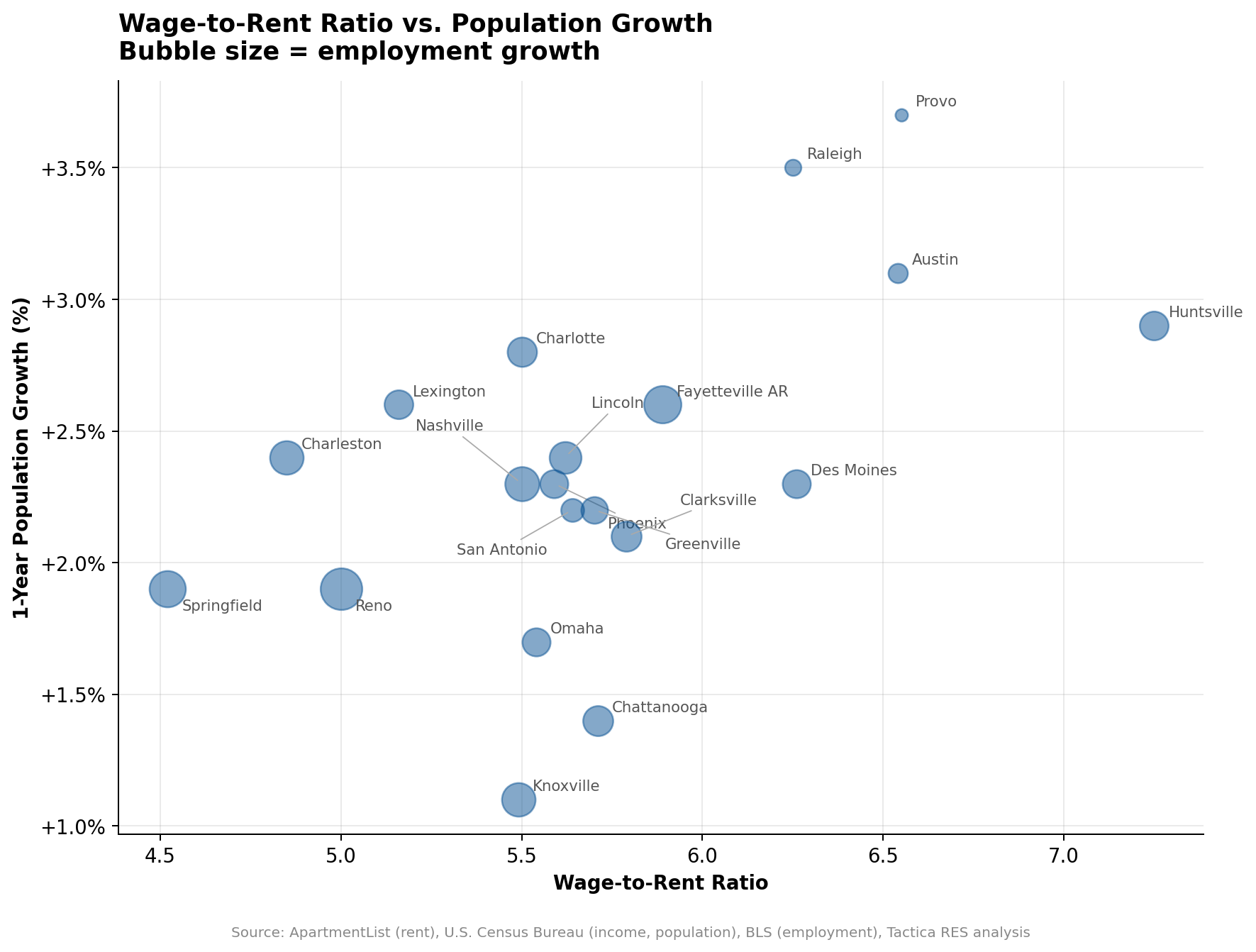
Huntsville, Alabama, is the standout. A 7.25x wage-to-rent ratio (the highest in the top 20), $87,049 median household income, a median rent of just $1,000, population growth of 2.9%, employment growth of 2.2%, and an unemployment rate of 1.9%, the lowest of any major metro in the country. The combination of a defense and aerospace-driven economy with extremely low rents creates significant affordability headroom.
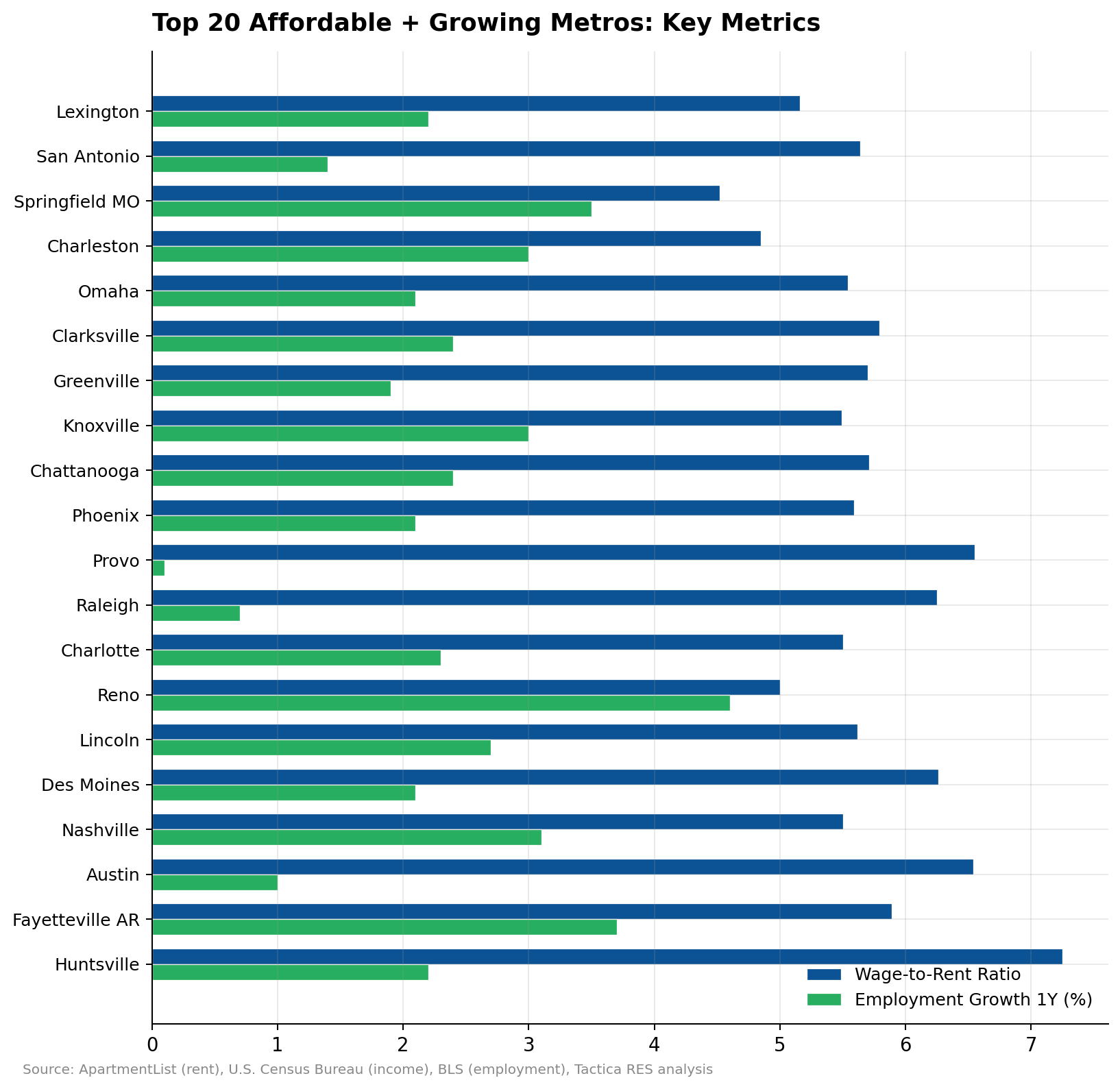
Fayetteville-Springdale-Rogers, Arkansas (home to Walmart headquarters and the University of Arkansas), posts a 5.89x ratio with 2.6% population growth and 3.7% employment growth. Austin, despite its well-documented rent declines, still shows a 6.54x wage-to-rent ratio, driven by its $99,897 median household income, suggesting the current rent correction may be creating a buying window for investors who believe in the long-term demand story.
The Regional Story: Sun Belt Dominates, But Not Exclusively
Thirteen of the top 20 are Sun Belt metros, which is not surprising given the region's sustained migration trends. But some of the most compelling entries come from outside the traditional Sun Belt.
Lincoln, Nebraska (5.62x, +2.4% pop, +2.7% emp, 2.8% unemployment) is a Midwest market that rarely appears on investor radar but posts fundamentals that rival those of much higher-profile metros. Des Moines, Iowa (6.26x, +2.3% pop, +2.1% emp, 3.3% unemployment) offers similar strength. Springfield, Missouri, rounds out the Midwest contingent. These markets offer what the Sun Belt increasingly struggles to provide: Moderate supply pipelines that will not overwhelm demand growth.
Reno, Nevada, stands out as the only Mountain West entry, with a 5.0x ratio and the highest employment growth of any metro on the list at +4.6%. Its proximity to the Bay Area continues to attract workers and companies from California, a structural tailwind for commercial real estate investment in the region.
Full Rankings: Top 20 Affordable and Growing Markets
| # | Metro | W2R | Rent | Med. Wage | Pop 1Y | Emp 1Y | Unemp |
|---|---|---|---|---|---|---|---|
| 1 | Huntsville, AL | 7.25x | $1,000 | $87,049 | +2.9% | +2.2% | 1.9% |
| 2 | Fayetteville-Springdale, AR | 5.89x | $1,148 | $81,208 | +2.6% | +3.7% | 3.1% |
| 3 | Austin, TX | 6.54x | $1,273 | $99,897 | +3.1% | +1.0% | 3.2% |
| 4 | Nashville, TN | 5.50x | $1,346 | $88,800 | +2.3% | +3.1% | 2.9% |
| 5 | Des Moines, IA | 6.26x | $1,137 | $85,446 | +2.3% | +2.1% | 3.3% |
| 6 | Lincoln, NE | 5.62x | $1,112 | $74,935 | +2.4% | +2.7% | 2.8% |
| 7 | Reno, NV | 5.00x | $1,486 | $89,159 | +1.9% | +4.6% | 4.0% |
| 8 | Charlotte, NC-SC | 5.50x | $1,302 | $85,938 | +2.8% | +2.3% | 3.6% |
| 9 | Raleigh-Cary, NC | 6.25x | $1,361 | $102,144 | +3.5% | +0.7% | 3.0% |
| 10 | Provo-Orem, UT | 6.55x | $1,286 | $101,014 | +3.7% | +0.1% | 3.5% |
| 11 | Phoenix, AZ | 5.59x | $1,343 | $90,133 | +2.3% | +2.1% | 3.5% |
| 12 | Chattanooga, TN-GA | 5.71x | $1,095 | $75,076 | +1.4% | +2.4% | 3.2% |
| 13 | Knoxville, TN | 5.49x | $1,127 | $74,184 | +1.1% | +3.0% | 2.9% |
| 14 | Greenville-Anderson, SC | 5.70x | $1,109 | $75,881 | +2.2% | +1.9% | 4.6% |
| 15 | Clarksville, TN-KY | 5.79x | $1,042 | $72,347 | +2.1% | +2.4% | 3.7% |
| 16 | Omaha, NE-IA | 5.54x | $1,272 | $84,524 | +1.7% | +2.1% | 3.2% |
| 17 | Charleston, SC | 4.85x | $1,552 | $90,307 | +2.4% | +3.0% | 4.1% |
| 18 | Springfield, MO | 4.52x | $1,238 | $67,219 | +1.9% | +3.5% | 2.9% |
| 19 | San Antonio, TX | 5.64x | $1,154 | $78,112 | +2.2% | +1.4% | 3.7% |
| 20 | Lexington, KY | 5.16x | $1,153 | $71,444 | +2.6% | +2.2% | 2.9% |
Disclaimer: Data sourced from ApartmentList (rent estimates, vacancy), the U.S. Bureau of Labor Statistics (employment, labor force), and the U.S. Census Bureau (population, demographics, housing). These agencies cannot vouch for analyses derived from their data. Rankings reflect Tactica RES methodology and are for informational purposes only, not investment advice.



The 25-to-34 age group drives apartment demand. We ranked 164 metros by growth in this cohort to map where productive renters are headed next.